Wet track driving: finding grip off the dry line
The fastest wet line is usually a car's width off the dry one, and finding it teaches more about grip than a lifetime of dry PBs.


In the wet the fastest way round a track is usually not the fastest way round it in the dry. The grip moves, usually a car's width outside the accepted racing line, and the lap is won on the straights, not through the corners. Learning to find it is one of the most useful afternoons a track-day driver can spend.
Where The Grip Goes
Tyre grip comes from two things. Adhesion is the chemical stickiness between rubber and road. Deformation is the rubber keying into the little peaks and valleys of the surface. In the wet, a film of water blocks adhesion, and deformation does most of the job.
That is why the off-line surface, the rough bit no one normally touches, is the useful one. Coaches split on why the dry line itself is so slick. Some blame rubber and dropped fluids baked into the ideal line. Others reckon wear has polished the surface smooth and taken the texture tyres key into. Either way, the grip is off the line.
Finding The Line
Treat every wet session as a new circuit. Do more sighting laps and build speed up gradually. Square the corner: brake deeper in a straight line, turn in later and sharper, pick the throttle back up earlier, and rejoin the dry line as straight as you can on exit. Crossing the rubbered strip at an angle, under power, is where the wet spin lives.
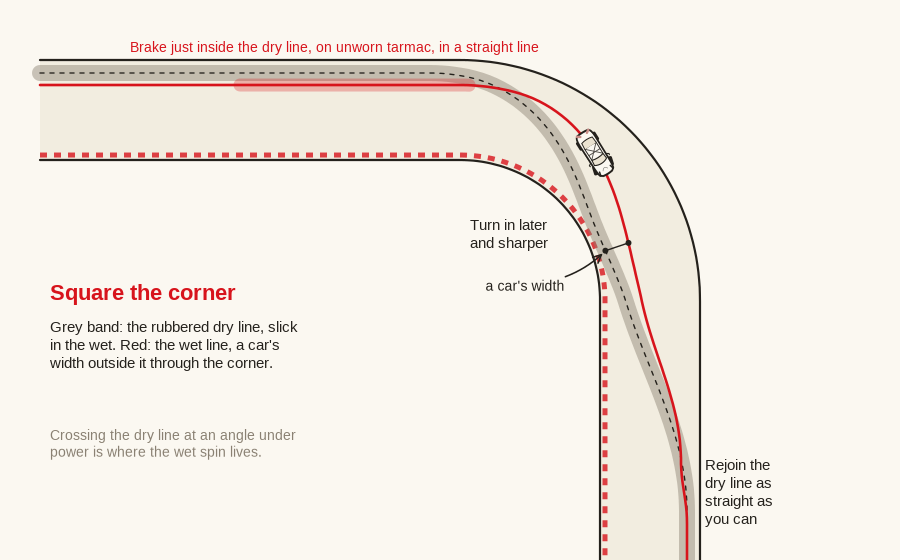
Brake just inside the normal dry line for unworn tarmac. Through the corner, aim a car's width outside the dry line, with a trace of understeer so the car is set rather than reacted to. Keep inputs smooth; a sharp brake release at turn-in can spin the car. A trace of wheelspin on power is useful feedback. If the car feels on rails, you are probably going too slowly.
The classic error is chasing cornering speed on the familiar dry line, where there is no grip to chase. Chicanes are a trap of their own: the dry line is often still the wet line. Wet kerbs, painted ones especially, are among the slipperiest surfaces on a circuit, and a hard hit pushes the pads back and lengthens the pedal.
If the water gets deep enough, aquaplaning lifts the tyres clear off the road: ease the throttle, no brake, no steering, hold straight until the tyres bite again.
How To Learn It
A proper wet session belongs on a skid pan or a wet track day with a school, where you can build up gradually and have someone watching from the pit wall. Treat the morning as an investment: learning to read a wet surface changes every dry lap after it. The road is not where any of this happens.
Where our facts came from
- Wikipedia: Aquaplaning (opens in a new tab) reference
- Driver61 (Scott Mansell): Circuit Driving in the Rain (opens in a new tab) press
- CAT Driver Training: Considerations for Wet Track Days (opens in a new tab) official
- Ross Bentley, Speed Secrets (Driving Directions): How to Be a Rain Meister (opens in a new tab) press
- Nigel Greensall / Racelogic Video VBOX: Advanced Circuit Driving Techniques, Article 9: Finding time in the wet (opens in a new tab) press


