Drifting, explained: the four parts of every slide
Every slide you have ever cheered through tyre smoke breaks down into the same four phases, judged against the same four criteria, and this is where the series starts.


Drifting looks like chaos and is extremely rules-bound. The driver deliberately oversteers and keeps the car sliding through the whole corner, rear slip angle larger than the front, hands on opposite lock. That is the trick. Judges score the run on four criteria: line, angle, style and speed, weighted 40 / 30 / 20 / 10 by the FIA. This is part one of eight, and the series hangs on four phases: initiation, transition, hold, exit.
The Physics
A drift lives in the gap between what the rear tyres can do and what the driver is asking of them. Unsettle the rear with a trail of brake, a flick of the steering, a jab of clutch or a yank of the handbrake. The back end rotates further than the front. The rear tyres are now sliding; the fronts are mostly steering; the car is pointing at a different angle to the direction it is travelling.
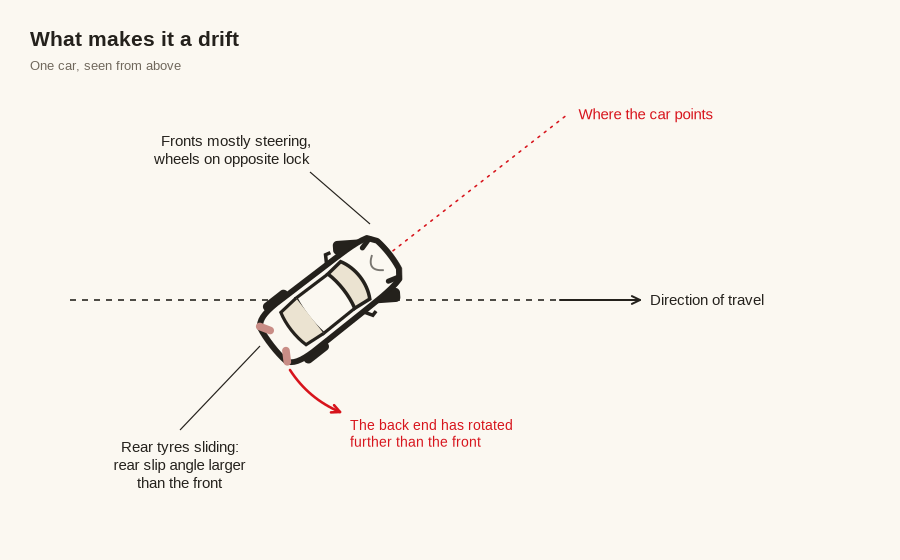
The tyres give grip back when you let them, and take it away when you ask again. The whole craft is managing that trade in small, honest movements. Weight transfer is the lever. Throttle, brake, clutch, handbrake and steering are the handles.
The Four Phases
There are four traditional ways to break traction: clutch kick, power-over, a weight-transfer feint (Scandinavian flick or deliberate lift-off oversteer) and the handbrake. Each does the same job by a different route. From there, the slide moves through four phases.
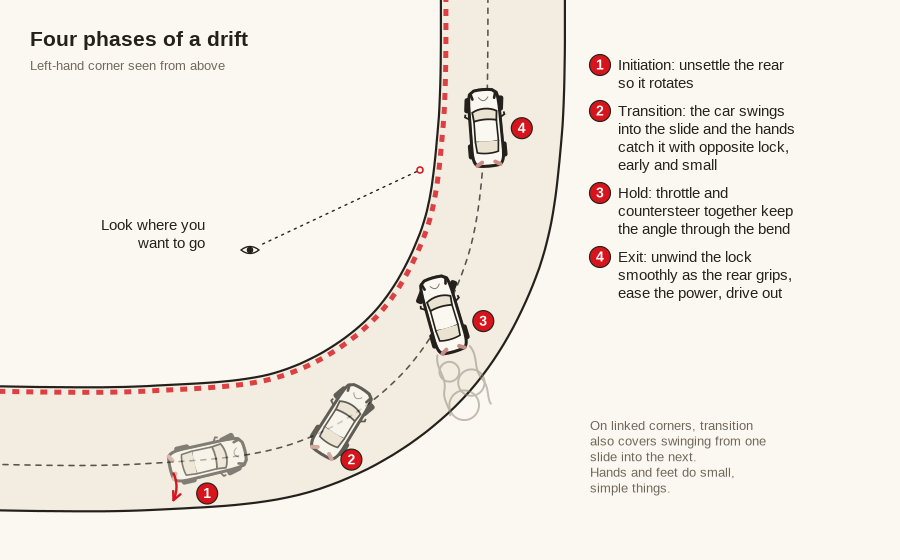
Initiation: unsettle the rear so it rotates. Transition: the car swings from grip into the slide and the hands catch it with opposite lock, early and small; on linked corners the same word covers swinging from one slide into the next, which gets its own part. Hold: throttle and countersteer together keep the angle through the bend. Exit: unwind the lock smoothly as the rear grips, ease the power, drive out.
DirtFish, which teaches all of this on dirt, boils the handbrake entry down to three words: "Clutch, Turn, Pull". I find it unnervingly similar to flat-pack furniture instructions. It works for exactly the same reason: do them in order or the thing falls over. The rule DirtFish puts underneath all of that is simpler. Look where you want to go. Hands and feet do small, simple things.
Three Ways To Score Zero
The scoring is less forgiving than the smoke suggests. Spin, in any zone, and the run is dead. Let the car wash back into blatant understeer and the run is dead. Put a single wheel off the track and the run is dead. Miss a clipping zone and your mark drops. The learner mistakes are the scoring mistakes, which is a slightly terrifying summary of the sport.
Where to turn up and try it: a skid pan or a licensed drift venue, with instruction and a helmet, never the public road. The FIA mandates helmets at every event. Our reference car across the series is a Toyota GR86: 231 bhp, rear-wheel drive, six-speed manual, Torsen limited-slip diff as standard. That last part is the one to remember.
Where our facts came from
- Wikipedia: Drifting (motorsport) (opens in a new tab) reference
- FIA: FIA Drifting Guidelines for Drifting Events (opens in a new tab) governing-body
- Toyota (GB) PLC: GR86 Tech Spec (2023) (opens in a new tab) manufacturer
- Toyota (GB) PLC: GR86 Equipment List (April 2024) (opens in a new tab) manufacturer
- DirtFish: How to do a handbrake turn (opens in a new tab) official
- Racer: Formula Drift announces major 2026 competition format changes (opens in a new tab) press
- Wikimedia Commons: File:King of Europe Round 3 Lydden Hill 2014 (14356011899).jpg (opens in a new tab) reference


