Trail braking: how to point a rear-drive car at the apex
Hold the brakes past turn-in and ease them off towards the apex, and a rear-drive car rotates into the corner instead of ploughing straight through it.


Trail braking teaches a rear-drive car to rotate into a corner rather than plough through it. You carry the brake past turn-in and ease it off towards the apex. That is the whole move. Brake pressure shifts weight forward, the fronts gain grip, and the car turns where it had been pushing wide. For a rear or mid-engined circuit car, this is the fix. Front-drive drivers should look elsewhere.
The Physics
The physics is honest, which I rather like. A tyre has a single budget of grip, and splits it between braking and cornering. Picture it as a circle: all braking at one edge, all cornering at another, and a smooth arc between. Pure brake, no steering. Pure corner, no brake. Anywhere else, you share.
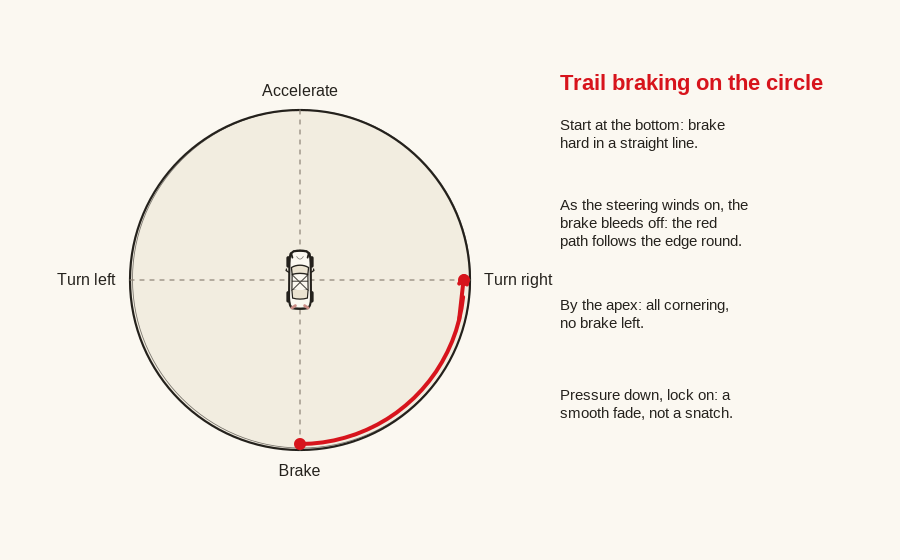
Press the brake and the nose dips. Weight moves onto the front tyres and the rear lifts. The loaded front axle now has more grip to point the car with, and the lighter rear is more willing to come round. Add some steering while the brake is still on and the fronts bite, the rears lose a little rotation budget, and the car turns where it had been ploughing.
How It Is Done
The sequence, as taught at the right kind of track day, runs like this. Brake hard and straight first. Begin to ease the pedal as you approach turn-in. Start to steer, and keep bleeding the brake off as the wheel winds on. Pressure down, lock on: the two should trade places in a smooth fade, not a snatch.
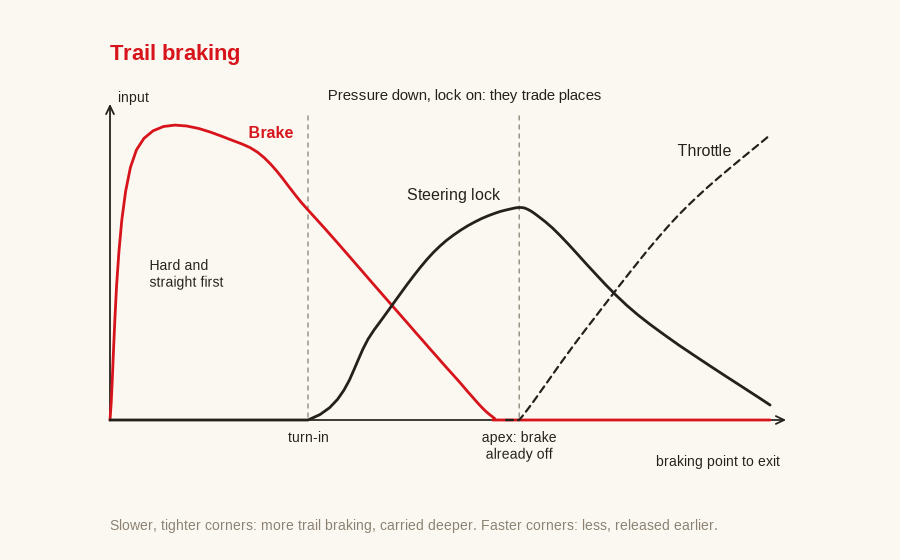
Be fully off the brakes just before the apex and get on the throttle. Full release can happen anywhere between turn-in and the apex, depending on the corner, but by the apex there is no brake left. That is the one rule to get right.
Slower, tighter corners ask for more trail braking, carried deeper. Faster corners ask for less, released earlier. What you are after is the car settling into the turn under the last of the brake, and leaning on the throttle from the apex out. It takes real seat time; no amount of reading replaces miles with a coach at your shoulder.
Two classic failures. Snap off the brake too quickly and the front pops up, the car runs wide, and you are mid-corner with no plan. Hold it on too long and the rear goes light enough to come round on its own: entry oversteer, uninvited. Near-neutral brake bias plus a greedy right foot and the back locks, the car pivots, and you are a passenger short of the apex.
Where To Learn
Skid pans, track days with tuition, and licensed driving schools are the right places for this. It is a grip-limit technique, which is to say there is no margin and no room to think again. A corner with limited run-off is the wrong classroom. Rally drivers use pulsed trail braking as a brake drift to rotate the car; most of the rest of us end up calling that a spin.


