Linking corners: giving up one to win the next
Fast flowing sections reward drivers who treat a run of corners as one problem, decide which one matters most, and spend the earlier ones accordingly.


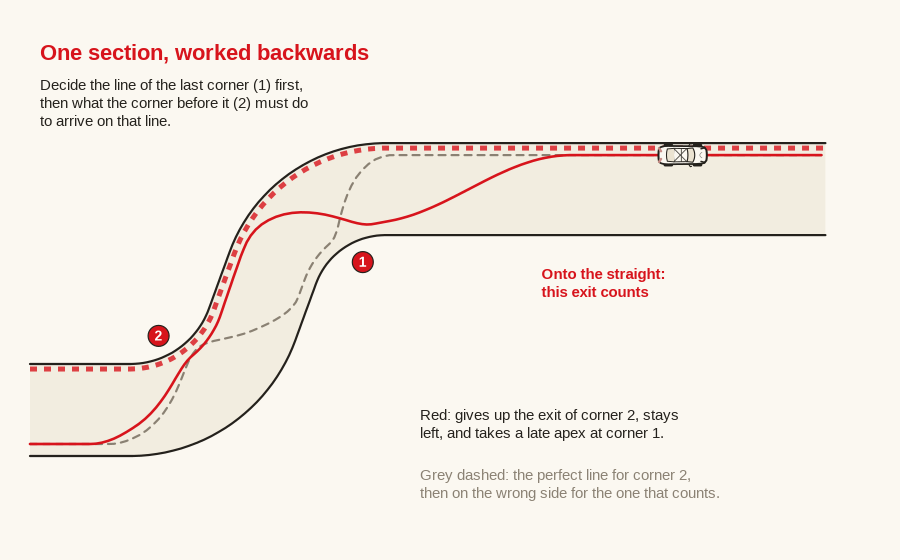
Some corners are a run of corners. Silverstone's Maggotts-Becketts-Chapel is one: three turns tied together because the car never truly runs straight between them. The fast way through is to stop thinking about three corners and think about one section, because on a lap the last of them counts most. It opens onto the Hangar Straight, and the rest exists to set it up.
The Physics
Grip is a budget. Every tyre has a finite amount of it, and at any instant it is being spent on braking, cornering or putting power down. Ask for more than it has and the tyre slides. That is the traction circle in a sentence.
The other half is geometry. Open the exit of a corner with a late apex, and the car can be pointed down the next straight sooner and the throttle fed in earlier. Tighten the exit with an early apex and the opposite happens: the car runs wide, the next entry is wrong, and the straight after it is lost.
Think of a compound corner as a single curve that happens to kink in the middle. The geometry does not reset between one corner and the next.
Working Backwards
Coaches teach it backwards. Walk the sequence or watch an onboard first, then decide the line of the last corner: where it apexes, where it exits. Only then do you ask what the corner before it has to do to arrive on that line, and only then what the one before that has to do.
The reference here is a track-day BMW 328i Coupé (E36), a rear-drive straight six on sticky tyres with a cage and a bucket seat. The car is happy to reward a settled chassis and quick to punish a rushed first apex.
Vision leads everything. By the time the car is at the first apex the driver should already be looking at the next one. For an esses sequence, the whole section is often one smooth input from lock to lock rather than a string of separate turns in and out.
The one honest exception: if the sequence feeds another braking zone instead of a straight, the priorities flip. Mid-corner speed earlier can matter more, and the sacrifice moves to the last corner.
Where It Goes Wrong
Two mistakes repeat. First, charging the first corner and arriving on the wrong line for the corner that counts. Second, picking an early apex there, which feels brilliant for half a second and then washes the car wide. Both come from seeing three corners when the car is in one. The passenger is still screaming about Maggotts while the driver should be looking at Chapel.
This is a track-only skill, and reading about it is not enough. The feel for it comes from laps, and the sight-lines only click with an instructor in the passenger seat pointing at the right apex a corner early. Track days, karting and ARDS-approved race schools are where it is learned. Walk the sequence first, or at least study an onboard of someone quick.
Where our facts came from
- Driver61: Master Different Corners & Techniques On Track (opens in a new tab) press
- High Performance Academy: Race Driving Fundamentals: Prioritising Circuit Corners (opens in a new tab) press
- Nigel Greensall (ARDS instructor): Advanced Circuit Driving: Compound Corners (opens in a new tab) press
- Blayze: Complex Corners (opens in a new tab) press
- Coach Dave Academy: Silverstone Track Guide (opens in a new tab) press
- BMW M: How to drive the perfect racing line (opens in a new tab) manufacturer
- BMW Group Classic: BMW 328i Coupé (E36) (opens in a new tab) manufacturer
- BMW Group Classic: BMW M3 (E36) 321 hp (opens in a new tab) manufacturer
- Wikipedia: Racing line (opens in a new tab) reference
- Evo: Silverstone: circuit in detail (opens in a new tab) press


