Smooth is fast: why slow hands make quick laps
The quickest drivers at the limit look bored, because the tyres only give their best to a driver who refuses to startle them.


Smooth is fast at the limit. Not slow; smooth. Each tyre has a budget of grip to spend on braking, cornering and acceleration, and a sharp input blows the budget before anyone feels anything slip. Coaches put it in different words, I am told, but the lesson is the same: sharp hands put a ceiling on lap time.
The fastest drivers look bored. The ones who look busy are usually queued up for recovery.
The Physics
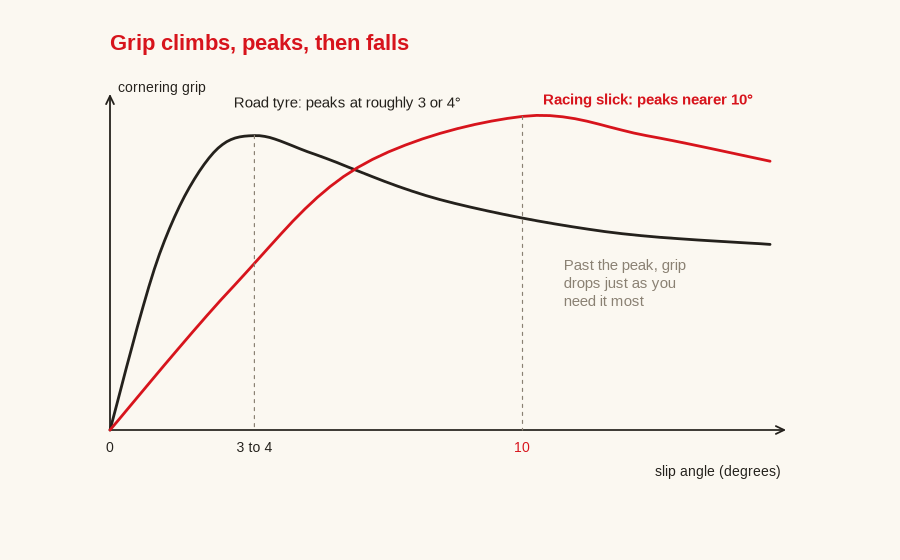
A tyre does not point exactly where it travels. The small gap between the two is slip angle, and grip climbs with slip angle, peaks, then falls off. A road tyre tends to peak at roughly three or four degrees. A racing slick peaks nearer 10 degrees. Past the peak, grip drops just as you need it most, and the driver usually finds out too late.
Each tyre also has one budget of grip to share between braking, turning and accelerating. Draw it as a circle: all brake at one edge, all corner at another, a smooth arc between. Load changes the budget. A tyre grips more under weight, but never as much more as you hoped. A sharp input that slams weight across the car loses grip even when nothing slides.
How It Is Done
Start with the brakes. Braking shifts load onto the front tyres and lightens the rear. Do it in a straight line before turn-in, not mid-corner, and release gradually as the wheel winds on. That way each tyre only ever does one job at a time, and the rear is not asked to grip while it is light.
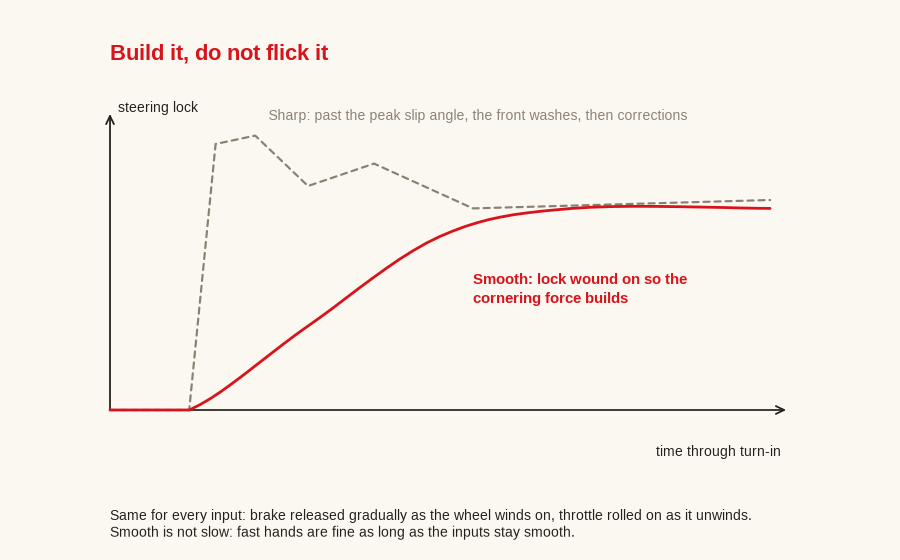
Steer like you are building pressure, not flicking a switch. Wind the lock on so the tyres' cornering forces build, not snatch. A sudden jerk past the peak slip angle drops the grip you were reaching for, and by then the lap time is already gone.
Then the throttle. Roll it on as the steering unwinds, not in one go. Full lock and full throttle do not share a tyre well. Every input, from brake to wheel to throttle, is one hand on one dial. The car wants them turned slowly.
Smooth is not the same as slow. Driving gently is one way to be smooth, but the point is to spend every bit of the grip budget, not to keep some in reserve. Fast hands are fine, so long as the inputs stay smooth.
The classic mistake is sharp hands on turn-in. The car answers for a moment, then the tyre runs past its peak slip angle, grip falls off and the front washes.
A reliable route to losing the rear is braking mid-corner: load shifts forward, the back lightens, and round it comes. Pushing too hard too soon turns a quick lap into a spin, which is slower than any amount of calm.
Where To Learn
Skid pans and licensed driving schools let you work on smooth control at speeds that are safe to get wrong. Rally schools let circuit racers rehearse car control on loose surfaces at low speeds, where the car is still cheap to fix. Track days with tuition are the next step. The public road is not the classroom, and never has been.
Where our facts came from
- Wikipedia: Slip angle (opens in a new tab) reference
- Wikipedia: Circle of forces (opens in a new tab) reference
- Driver61: Driving at the Limit on Track (opens in a new tab) official
- Driver61: How to Find Grip on the Race Track (opens in a new tab) official
- Team O'Neil Rally School: Weight Transfer for Driving, Racing and Rally (opens in a new tab) official
- Speed Secrets (Ross Bentley): Is Smooth Really Fast? (opens in a new tab) press
- BFGoodrich: The Art of Cornering by BFGoodrich (opens in a new tab) press
- Mazda Motorsports (Tom Long): Be Smooth (opens in a new tab) official


