The racing line: turn-in, apex and exit
Why the fastest way through a corner is a late-apex compromise, framed for the track day, not the roundabout on the way home.


The racing line is the path that gets you around a lap in the shortest time, and it is not the line that feels fastest. A corner has three honest phases: braking and turn-in, apex, and exit. Get the exit right and the gain carries down the next straight. Get only the entry right and you look tidy on your way to a slower lap time.
The Physics In Plain Words
Your tyres have a grip budget, often drawn as a traction circle. You can spend all of it on braking, all of it on cornering, or a bit on both, but you cannot spend more than you have. Try, and the car runs wide.
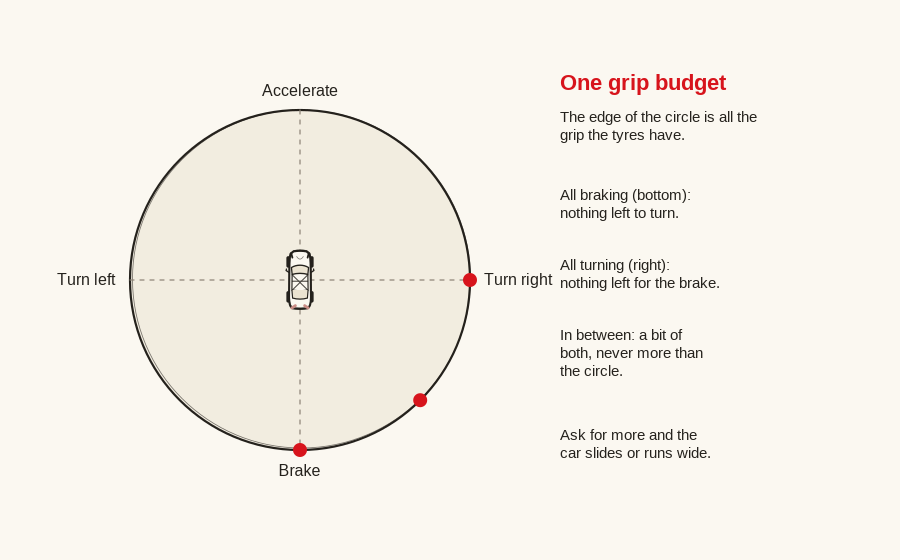
That is why braking is done in a straight line, before turn-in: all the grip for stopping, then all of it for turning. It is also why the geometric line, which apexes at the corner's midpoint on a constant radius, is the reference case, not the villain. On paper it has the highest minimum speed. On a stopwatch, a late-apex line often beats it, especially before a straight.
How It Is Done
Brake hard, in a straight line, before you turn. Let the car settle. Then turn in later than feels right, aim for a late apex, and only clip it when the car is already pointing at where you want to go next. From the apex, unwind the steering as you feed in throttle, so the car straightens under acceleration rather than fighting the wheel against the power.
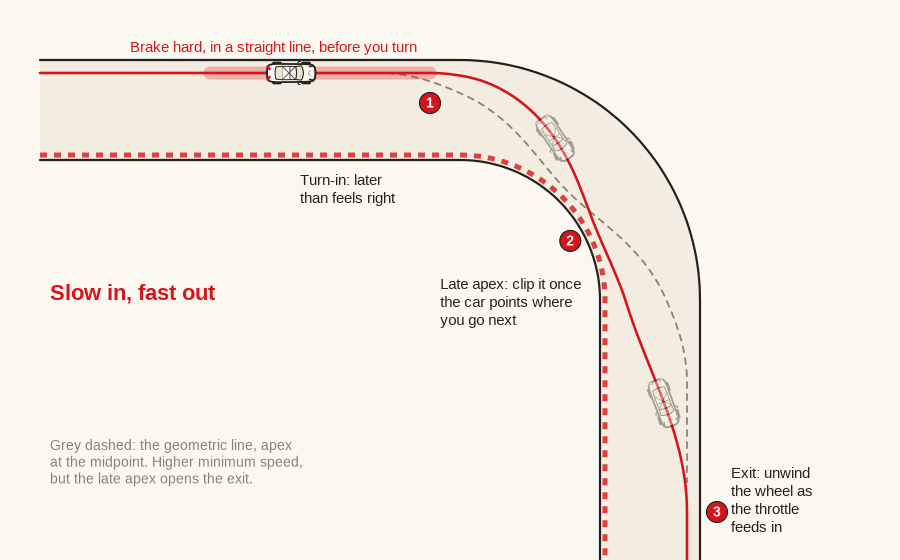
The late apex tightens entry on purpose and opens the radius of your exit, which lets you go on the throttle sooner. "Slow in, fast out" is the rule of thumb every instructor hands you. It stays a rule of thumb: through linked corners, the quickest driver sacrifices the first apex to set up the second.
The famous mistake is the early apex. You turn in too soon, the entry feels fast, the exit radius tightens, you run out of road, and you lift at the moment you should be accelerating. Everyone does it the first time. Then they meet the exit kerb. Turning in too late is the quieter mistake: you scrub off speed and gain nothing for it.
Where To Learn
Not on the way to Tesco. Book a track day, a karting session or a skid pan, or a day at an ARDS-approved race school with an instructor in the passenger seat. Karting teaches the line cheaply and fast. A skid pan teaches you what the car does when you ask for more grip than you have. Both are better teachers than any road, and legal.
Where our facts came from
- Motorsport UK TV: Perfecting Your Racing Line (opens in a new tab) governing-body
- Driver61: How to Drive the Perfect Racing Line (opens in a new tab) official
- Silverstone Circuit: Karting Explained: The Racing Line (opens in a new tab) official
- Silverstone Circuit: If you can feel grip you can go fast: meet Drive Silverstone instructor Peter Bennett (opens in a new tab) official
- Wikipedia: Racing line (opens in a new tab) reference
- BMW M: How to drive the perfect racing line (opens in a new tab) manufacturer


