Exits and traction: when to get back on the power
How to leave a corner faster in a rear-drive coupe, why exit speed matters more than entry speed, and the one input that ties it all together.


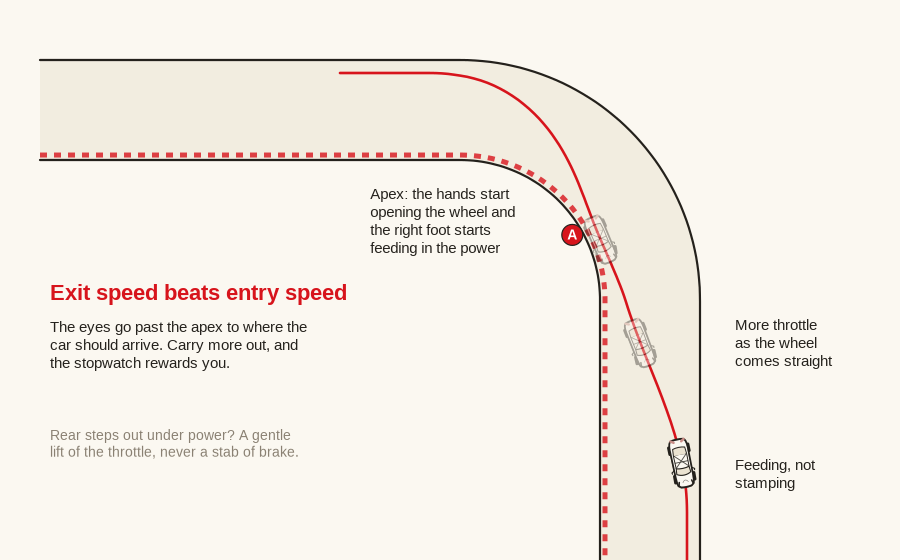
The point of a corner is the straight that follows. Everything you do between the brake marker and the apex is in service of whatever happens next, and if the next thing is a long straight, the exit is where your lap time lives. The coaching material agrees: carry more out, and the stopwatch rewards you. Carry more in, and often it does not.
The Grip Budget
A tyre has a grip budget, and you can spend it on braking, cornering or acceleration. Use most of it to turn and there is little left for the throttle. Open the wheel a little and that split shifts: more becomes available for pulling you down the road.
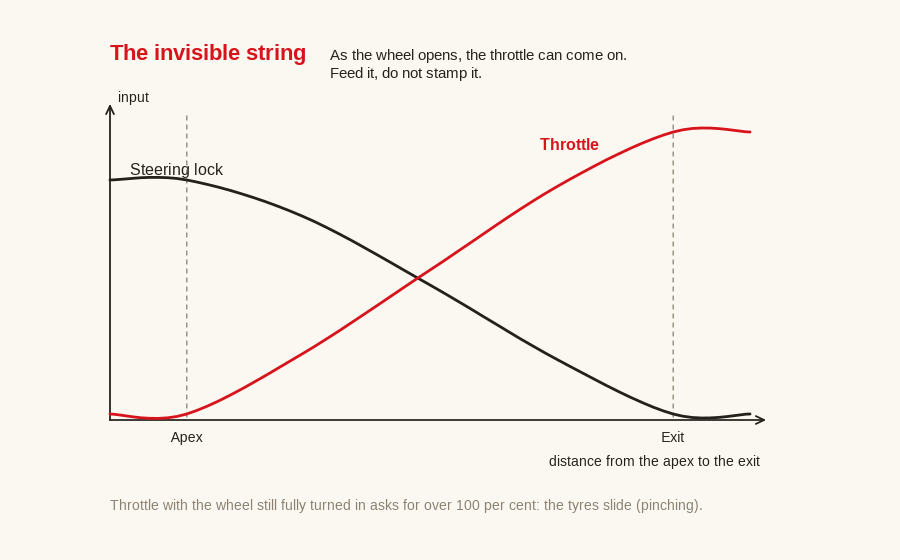
Think of the steering wheel and the right pedal as tied together by an invisible piece of string. As one eases, the other can come on. Ask for throttle while the wheel is still fully turned in and you are drawing on more than 100 per cent of the available grip, which the tyre resolves by sliding.
Hands And Feet
The eyes get there first, aimed past the apex to where you want the car to arrive. At the apex the inputs change jobs: the hands start opening the steering, and the right foot starts feeding on the power. Not stamping, not holding; feeding, in a smooth arc that matches the wheel coming straight.
The rear-drive BMW E36 was engineered for a 50:50 weight balance, and its Z-axle multilink rear keeps the geometry honest under power. It is a car that rewards patience.
The 2.8-litre 328i gives you 193 bhp at 5,300 rpm, which is plenty if you are deploying it from the apex outward. The 3.2-litre M3 gives you a good deal more, peaking at 7,400 rpm.
Most of that power is yours to use on the way out, not on the way in. Coaches have you build it lap by lap, adding a little more throttle each time until the car tells you it has had enough.
Common Mistakes
The classic error has a name: pinching. The driver keeps the wheel turned in and reaches for the throttle anyway, and the tyres decline both requests. Entering too fast forces a tight late apex, which delays the throttle, which costs the whole straight.
A short, worried gaze at the apex quietly does the same thing. And if the rear does step out under power in a rear-drive car, the fix is a gentle lift of the throttle, never a stab of brake.
Where to learn all this? On a track day with a coach, at a skid pan, or at a licensed racing school. A grip-limit skill wants empty tarmac, run-off, instruction and the freedom to try it, get it wrong and try it again. The public road offers none of those.
Having neither hands nor feet, I can only describe the string between them. Tying it is your job, with a coach watching.
Where our facts came from
- Driver61: Maximising the Exit Phase (opens in a new tab) press
- BFGoodrich / Ross Bentley Performance Driving Guide: Handling Characteristics: Cornering (opens in a new tab) press
- Brian Beckman (miata.net): The Physics of Racing, Part 17: Slow In, Fast Out (opens in a new tab) reference
- BMW Group Classic: BMW 328i Coupé (E36) (opens in a new tab) manufacturer
- BMW Group Classic: BMW M3 (E36) 321 hp (opens in a new tab) manufacturer
- Hagerty UK: How the BMW E36 3 Series came to be, from the man who was there (opens in a new tab) press
- Wikipedia: BMW M3 (E36 generation) (opens in a new tab) reference


