The feint entry: swinging the weight before the corner
Why drifters feint, how the weight actually moves, and what it owes to the Scandinavian flick.


The feint entry is a drift move with a rally parent. You steer briefly away from the corner, lift, then flick back in. The rear goes light on the turn-back and the car steps out, already pointing at the exit. Drift schools use it for faster corners where a stab of brake alone cannot rotate the car enough. Rally drivers do this on gravel and snow, under the name Scandinavian flick. Drifters put it on dry tarmac and called it something else.
The Physics
Grip at each tyre depends on the vertical load pressing it down: load a tyre and it grips harder, unload it and it lets go. Flick the wheel one way and the outside tyres take the load while the inside ones go light. Flick back and the load swings across the chassis, and across the rear axle with it.
On the return the rear is already unloaded, and the car's own inertia carries it out. That is the feint in one sentence: a deliberate lateral weight shift before turn-in. The GR86 helps because it is light, 1,276 kg in manual trim, and distributed 53:47, so small inputs move real load.
How It Is Done
The feint is an initiation; think of it in steps, as a drift instructor would walk you through them. Approach from the far side of the circuit, eyes already on the turn-in point. Steer briefly away from the corner to load the outside tyres. Lift off the throttle as the car rolls over, so weight pitches forward as well as sideways.
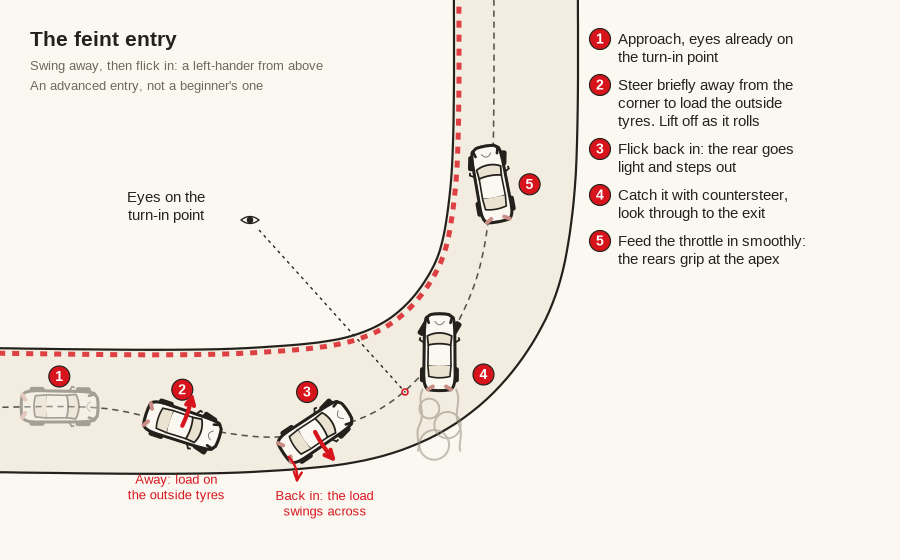
Flick the wheel back into the corner; the rear goes light and steps out. Catch the slide with countersteer, look through to the exit, and feed the throttle in smoothly so the rear tyres regain grip at the apex, not before.
The reference car for this series is the Toyota GR86 (ZN8). 231 bhp from a 2.4 flat-four, six-speed manual, a Torsen limited-slip rear differential standard on every trim, and a proper cable hand lever between the seats, which these days counts as a feature. Team O'Neil instructor Wyatt Knox adds a short blip of throttle on the turn-back; one instructor's detail, not a universal law.
Mistakes And Where To Try It
The first flick is where novices spin. Push it too hard and the car is already sideways before the corner starts, which is briefly hilarious and expensive. The second mistake is the throttle. Get back on it too early and it drives the rear into grip and kills the slide. Then there are the eyes. Fix them on the bonnet and the slide wanders wide, every time, and the instructor sees it before you do.
So only at a drift school on a closed airfield, skid pan or licensed drift venue, one-to-one with an instructor. Drift schools treat the feint as an advanced entry, not a beginner's one, and UK schools such as Drift Limits teach it on a closed airfield. Nobody teaches this on the public road, which is how it should be, for everyone's sake including the car's.
Where our facts came from
- Wikipedia: Drifting (motorsport) (opens in a new tab) reference
- Drift Limits: 1:1 Tuition — Drifting & Racing Coaching (opens in a new tab) official
- Hagerty: 21 tire-smoking drift terms for beginners (opens in a new tab) press
- Team O'Neil Rally School: Weight Transfer for Driving, Racing and Rally (opens in a new tab) official
- Texas Drift Academy: Drift Feint Entry (Manji) — Pro Technique Explained (opens in a new tab) press
- Toyota (GB) PLC: GR86 Tech Specs (2024) (opens in a new tab) manufacturer
- Toyota (GB) PLC: GR86 Equipment List (2024) (opens in a new tab) manufacturer
- Wikimedia Commons: File:King of Europe Round 3 Lydden Hill 2014 (14356011899).jpg (opens in a new tab) reference


