The clutch kick: a shock to the rear tyres
Part three of our drift series: how to spike torque at the rear wheels with the clutch pedal, and the parts bill it hands you.


The clutch kick is the drifter's answer to a low-speed corner on a high-grip surface. You hold the throttle, dip the clutch, drop it. Torque spikes at the rear wheels, the Torsen diff passes it to both, and the car slides where a stab of accelerator alone would just make noise. That is the technique in a sentence. The rest of this article, I am afraid, is the cost.
The Physics In Plain Words
The rear tyres only slide when the force you ask of them exceeds the grip they have. On a low-grip skid pan, throttle alone can be enough. On dry tarmac the tyres just dig in: you need a bigger torque spike than the engine can make on its own.
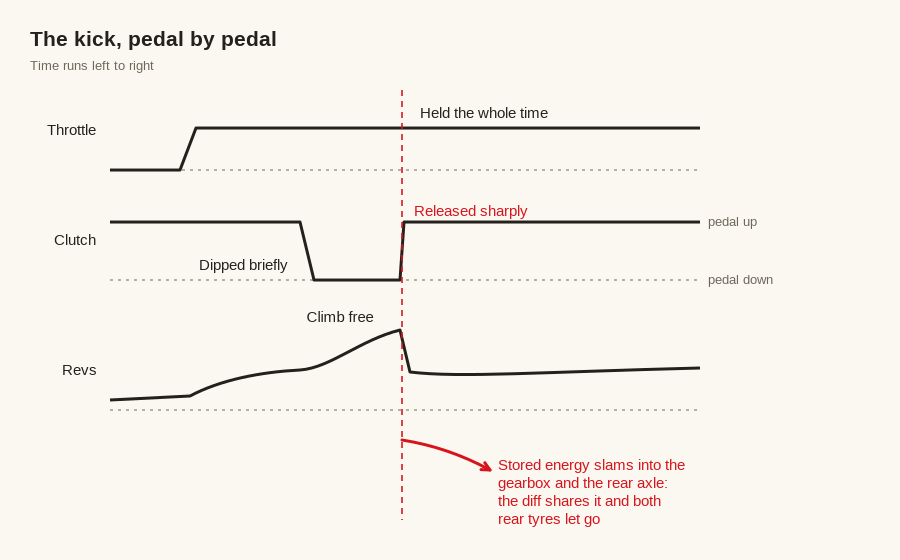
That is what the clutch pedal buys you. With the pedal down, the engine pulls against nothing and the revs climb free. Release it sharply and all of that stored energy slams into the gearbox and the rear axle at once. The limited-slip diff shares it across both back wheels, and both let go together. Think of shoving a stuck trolley rather than leaning on it.
How It Is Done
Turn in with eyes already on the exit. The throttle is held from here on. This is the one thing to get right: lift as the clutch comes out and you have performed a bad gear change, not an initiation.
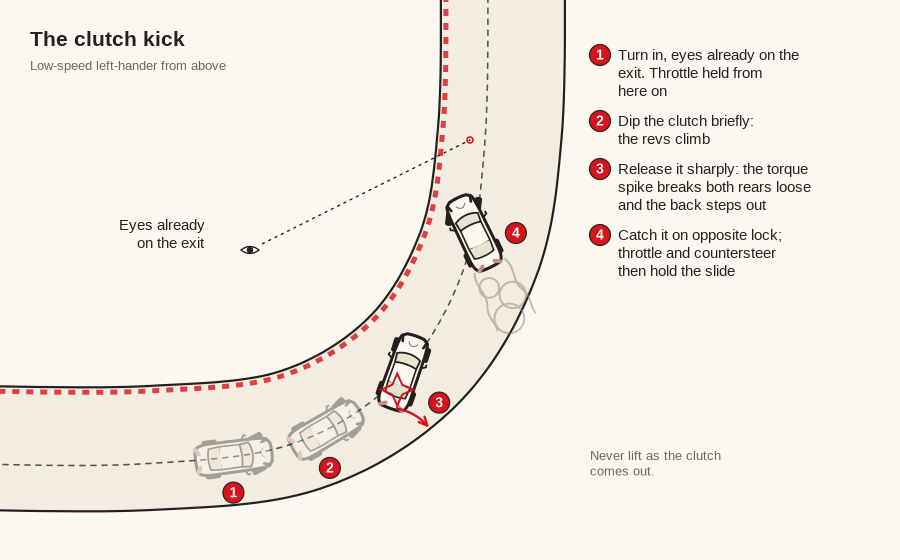
With the throttle held, dip the clutch briefly. The revs climb. Release the clutch sharply, not slowly. The rear tyres break traction, the back end steps out, and you catch it on opposite lock. That is initiation and transition done; from here throttle and countersteer together hold the slide.
For the handbrake basics that come first, the GR86 has a mechanical hand-lever parking brake, cable-operated, not electronic: a spec-sheet gift. The 2.4-litre flat-four peaks at 184 lb ft at 3,700 rpm, so there is torque to kick with.
The biggest mistake, again, is lifting off as the clutch comes out. The next is reaching for the clutch at speed on dry tarmac, when trail braking would do the same job without a receipt.
Every kick shock-loads the clutch plate, the throwout bearing, the gearbox input shaft, the driveshafts and their bushings. The result is premature wear: expect to replace those parts sooner than an owner who never kicks the clutch.
Where To Learn
A skid pan at a licensed drift school, with an instructor. Never on the public road, not even once. Drift Limits in the UK teaches the handbrake pull first, then puts the clutch kick at Level 2, by which point you have signed yourself up to pay for the clutch. From £32,495 the GR86 ships with the full kit: six-speed manual, Torsen diff, that cable handbrake. Every trick is in the box. Budget accordingly.
Where our facts came from
- Toyota UK Media: Toyota announces pricing and specification details for the new GR86 coupe (opens in a new tab) manufacturer
- Toyota UK Media: GR86 Tech Specs (April 2024) (opens in a new tab) manufacturer
- Toyota USA Newsroom: All-New 2022 Toyota GR 86: Thrills Around Every Corner (opens in a new tab) manufacturer
- Toyota USA: 2024 Toyota GR86 Features (opens in a new tab) manufacturer
- Team O'Neil Rally School: Clutch Kicking Explained (opens in a new tab) official
- Drift Limits: 1:1 Tuition — Drifting & Racing Coaching (opens in a new tab) official
- Autocar: Toyota GR86 goes back on sale in the UK (opens in a new tab) press


