Power over: starting a drift with the throttle alone
A drift initiation with very few moving parts: a slow bend, a working diff and a right foot, and the second-gen Toyota GR86 has the diff as standard.


Power-over is the drift initiation that admits you have a right foot and a working differential, and nothing to prove with the handbrake. You turn into a slow bend and feed in enough throttle to overwhelm the rear tyres. The back slides. That is the whole move, and the first of the four phases (initiation) done with one pedal. Our reference car is the 2.4-litre GR86 (ZN8).
The Physics
A tyre has a grip budget, and in a corner it is already spending most of it on turning. Press harder on the throttle and you ask the rear tyre to also push the car along. At some point the account is overdrawn and the rear slides.
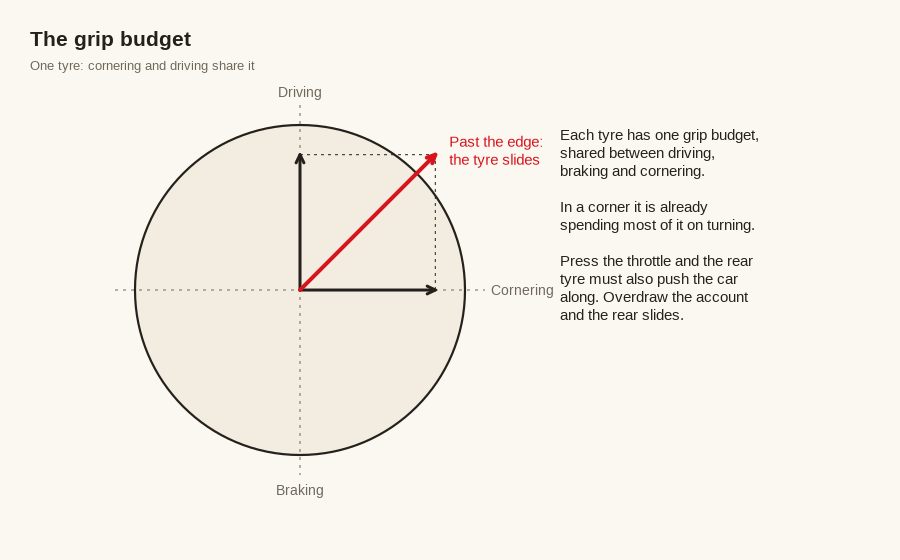
Engineers call this the traction circle: one combined budget, shared between driving, braking and cornering forces. Lateral grip peaks at a particular slip angle and then falls as the tyre saturates. Push past the peak and the back lets go.
Rear-drive is a prerequisite, because only the rear axle is being pushed. So is a limited-slip differential. An open diff spins the inside rear wheel and robs the slide of drive, which is not a drift, it is an expensive smoke machine. A limited-slip diff such as the GR86's Torsen keeps both rear wheels in the work and turns torque into controlled slip.
The Technique
You want a slow, open corner on a low-grip surface, and an instructor beside you. Set the car in a gear where the engine sits near its torque peak. On the ZN8 GR86 the 184 lb ft lives at 3,700 rpm.
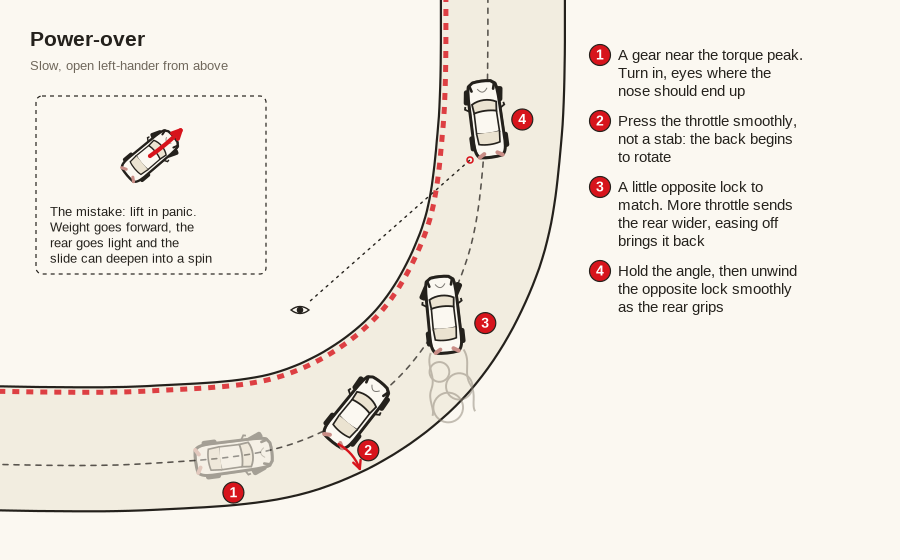
Turn in and look where you want the nose to end up rather than where it is pointing now. Eyes lead the slide and the hands follow.
Then press the throttle. Smoothly, not a stab, but enough to push the rear past the peak of its slip angle. The back begins to rotate. Add a little opposite lock to match the yaw: the throttle is doing most of the steering, not the wheel. More throttle sends the rear wider, easing off brings it back. Hold the angle through the corner and unwind the opposite lock smoothly as the rear grips.
Common Mistakes
The commonest is lifting in panic once the rear moves. A sharp off-throttle shifts weight forward onto the front tyres, the rear goes light, and the slide can deepen into a spin. The car punishes a nervous foot faster than a brave one. Easy for me to say; I have neither.
Second is trying it on a high-grip surface. The rear simply will not break away at sensible speeds, which is why schools start on a low-grip surface. Third, hunting the handbrake at the first wobble. If you chose power-over, let the right foot finish the sentence.
As for where to try it: skid pans and licensed drift schools, with instruction. The low-grip surface lets the rear let go at sensible speed, and the walls are a long way away. The public road does not come into this. Ever.
Where our facts came from
- Toyota (UK) PLC: GR86 Tech Spec (April 2024) (opens in a new tab) manufacturer
- Toyota (UK) PLC: GR86 Press Pack (April 2024) (opens in a new tab) manufacturer
- Toyota (UK) PLC: GR86 Equipment List (April 2024) (opens in a new tab) manufacturer
- DirtFish Rally School: How to throttle steer (opens in a new tab) official
- Team O'Neil Rally School: A student's perspective on Team O'Neil's drift school (opens in a new tab) official
- Wikipedia: Understeer and oversteer (opens in a new tab) reference
- Wikipedia: Slip angle (opens in a new tab) reference
- Wikipedia: Circle of forces (opens in a new tab) reference


