Transitions: switching a drift without spinning the car
Why the smoothest bit of a drift run is one of the hardest, how weight transfer swings the rear across the car, and where to go and learn it.


In part one, transition is the phase where the car swings into a slide and the hands catch it. On linked corners it is the moment one drift swings into the next, in the opposite direction. Nothing much happens for a beat, and that beat is one of the hardest parts of drifting. Get it wrong and the car starts looking like an expensive hot hatch understeering.
Our reference car is the Toyota GR86 ZN8: 231 bhp, 184 lb ft, 1,276 kg, a Torsen limited-slip diff and, mercifully, a cable handbrake lever.
The Physics
Transitions are a weight problem, not a steering one. In a corner, load is already on the outside tyres. Lift the throttle and load moves forward too, so the inside rear goes light twice over. That lightness is what lets the back of the car swing across to the opposite side. The steering wheel follows; it is a passenger carrying out instructions the chassis has already written.
Total load on the four tyres never changes. You are not making grip; you are just deciding which corner of the car has it next. Weight transfer, coaches at Team O'Neil say, is the most basic foundation of vehicle dynamics. It sounds like a diet plan, and it is really a confession that the wheel in front of you does less than you think.
How It Is Done
Set the first drift and settle it with throttle. As the car approaches the next direction change, lift off the throttle just enough for the rear tyres to grip up a touch, then meet the wheel as the weight shifts and the car swings across. Do not pull at the steering; the car is already rotating, and your job is to meet it with the right amount of lock, not to force it.
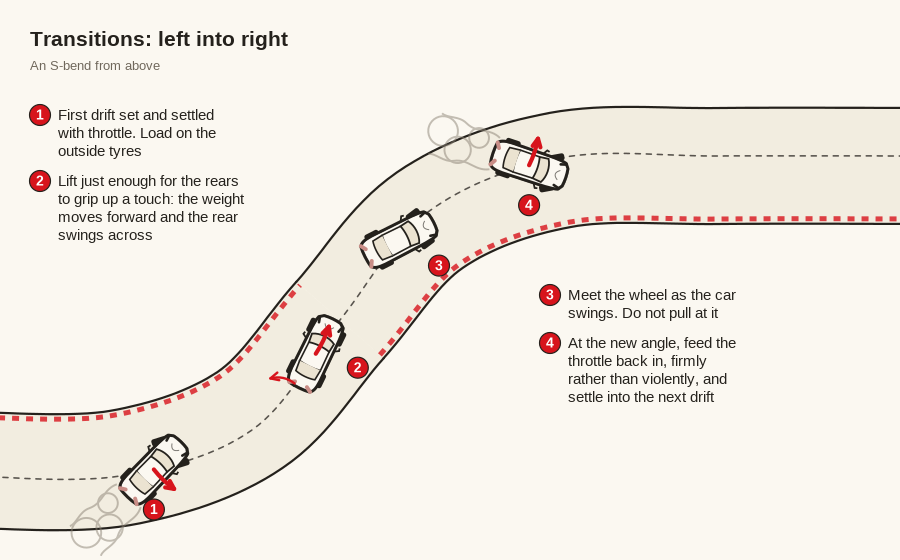
As the rear arrives at the new angle, feed the throttle back in, firmly rather than violently, and settle into the next maintenance drift. In the GR86, the Torsen limited-slip diff makes this part honest: both rear tyres share the power, so a lift that is mistimed or too deep shows straight away.
Judges reward smoothness here. Drift Masters' 2026 scorecard devotes 20 points to Style, split five for Initiation, 10 for Fluidity and five for Commitment. Fluidity, smoothness lock to lock, gets half of it.
Mistakes and Where to Learn
Snap the throttle shut and the rear flicks too far across; the car spins, politely and unmistakably, into a double-direction mess. Ease off too gently and the rear never unloads, the nose washes wide, and you have invented understeer in a 1,276 kg rear-drive coupe, which is embarrassing for everyone. Judges deduct for double initiation and for straightening early too, so even a saved transition costs you points.
Not on the road. Never on the road. A skid pan or a licensed drift venue with instruction, cones to flatten rather than kerbs to clip; competition drift cars carry a racing seat and a five-point harness for good reason. If you have done a first drift course, this is the next skill: linking corners rather than holding one. If you have not, part one of this series and our weight transfer explainer are the place to start.
Where our facts came from
- Formula DRIFT Holdings, LLC: 2026 Formula Drift Judging Regulations, Version 1.3 (opens in a new tab) official
- Drift Masters: Drift Masters 2026 Judging Rules (opens in a new tab) official
- Wikipedia: Drifting (motorsport) (opens in a new tab) reference
- Wikipedia: Weight transfer (opens in a new tab) reference
- Wikipedia: Lift-off oversteer (opens in a new tab) reference
- Team O'Neil Rally School: Weight Transfer for Driving, Racing and Rally (opens in a new tab) official
- Drifted: How To Drift: The Complete Guide (opens in a new tab) press
- Toyota (GB) PLC: GR86 Tech Spec (2023) (opens in a new tab) manufacturer
- Toyota (GB) PLC: Toyota Presents the New GR86 (opens in a new tab) manufacturer
- Toyota Motor Corporation: TOYOTA GAZOO Racing Launches the All-New GR86 (opens in a new tab) manufacturer
- Toyota Parts Deal: OEM Toyota GR86 Parking Brake Cable (SU003-08828, SU003-08829) (opens in a new tab) reference
- Wikimedia Commons: File:Formula DRIFT on Track 2012.jpg (opens in a new tab) reference


