The braking drift: using the brakes to unload the rear
Why one professional drifter calls it the hardest drift entry to learn and the best one to feel, and why the Toyota GR86 suits it so well.


The braking drift is a weight-transfer entry: brake hard on the way in to shift weight forward and unload the rear, then catch the rotation on throttle. Wikipedia does not list it as a separate method; it sits inside the weight-transfer family with lift-off and the Scandinavian flick, so treat the name as a working label.
Fredric Aasbo has called it the hardest way to drift and the one that yields the best feeling. I'd add that this is, give or take, the review every driver writes of their own first attempt.
The Physics
Grip is a budget. Each tyre has a total amount of it, and braking and cornering must share the account. Lean hard on the brakes and almost all of the budget goes to stopping. Add steering, and the front tyres have to spend some of it on turning instead.
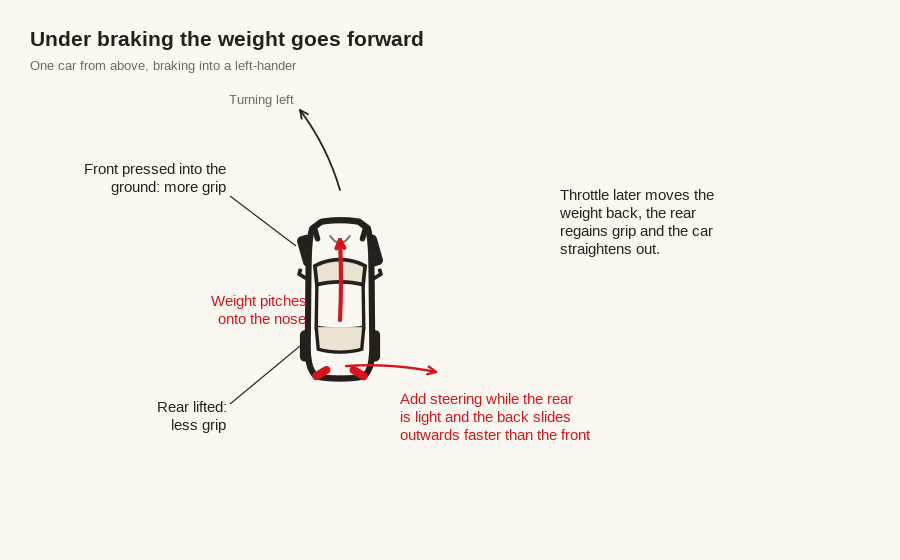
Meanwhile the car's weight pitches forward onto the nose, pressing the front into the ground and lifting the rear. The front gets more grip. The rear gets less. Add steering lock while the rear is light, and the back of the car slides outwards faster than the front. That is rotation. Throttle later moves the weight back, the rear regains grip, and the car straightens out.
How It Goes
Approach the corner with the gearbox in the right ratio and both eyes on the apex. Lift off the throttle first, so the weight starts moving forward on its own. Squeeze into the brakes with steady pressure, turn in, and let the pressure and the steering do the work together.
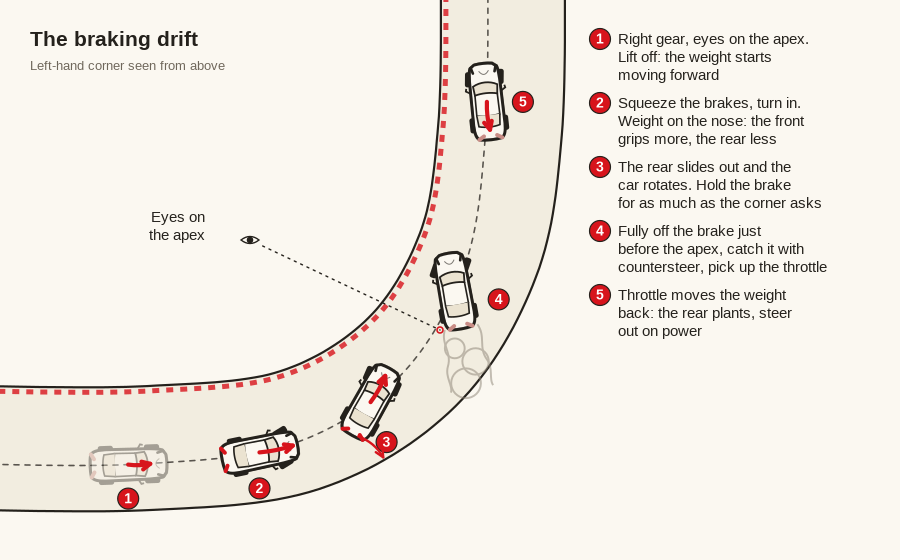
The rear slip angle climbs past the front, and the car begins to rotate. Hold the brake long enough to get as much rotation as the corner is asking for. Tighter and longer corners want more; gentler ones want less. Then be fully off the brake just before the apex, catch the rotation with countersteer, and pick up the throttle.
The rear plants, the car settles, and you steer out on power. Trail braking is the same idea with the volume down: the pressure eases as the steering winds on. Rear and mid-engined cars take to it; front-wheel drive cars make limited use of it.
The common failures cover roughly every pedal you have. Release the brake too quickly and the front unloads: the car refuses to turn. Hold it too long and the rear snaps loose and over-rotates into a spin. Get on the throttle before the car has turned in and it understeers. Staying on power and ploughing wide can feel fast. It is a long way of going sideways slowly.
Where To Learn It
Not on the public road, and not on anything with a white line down the middle. This is a grip-limit technique that needs real seat time: a skid pan, a closed rally stage, a circuit or a licensed drift school, always with an instructor, who shortens the learning curve. The Toyota GR86 (ZN8) suits it almost suspiciously well: a Torsen limited-slip diff standard, 1,276 to 1,316 kg of kerb weight, and a Track mode that widens the VSC thresholds.
Where our facts came from
- Toyota (GB) PLC: GR86 Tech Specs (2024) (opens in a new tab) manufacturer
- Toyota (GB) PLC: GR86 Equipment List (2024) (opens in a new tab) manufacturer
- Toyota (GB) PLC: Toyota Presents the New GR86 (opens in a new tab) manufacturer
- DirtFish Rally School: How to use the brakes (opens in a new tab) official
- Driver61: How to Trail Brake (opens in a new tab) press
- CarThrottle: 5 Ways To Initiate A Drift (opens in a new tab) press
- Wikipedia: Drifting (motorsport) (opens in a new tab) reference
- Wikimedia Commons: File:2022 Toyota GR86 Premium in Halo, Front Right, 04-10-2022.jpg (opens in a new tab) reference


