Cooling and oil: keeping a drift engine alive
Before your SR20DET makes more power, a bigger radiator, a cooler on the oil, and a baffled sump are what stop it eating itself halfway through the day.


A drift engine does not die from one big moment. It dies from heat, and from oil that slid away from the pickup while the car was at full lock. On a Nissan 200SX S14a, the facelifted S14 with the ball-bearing SR20DET turbo from 1996, the cure before the big power build is a bigger radiator, an oil cooler on a thermostatic plate, and a baffled sump. Everything after that is optional.
How It Works
The S14a's SR20DET is a 1,998cc turbocharged four on 8.5:1 compression, driving the rear wheels through a five-speed manual and, commonly, a factory viscous limited-slip diff. JDM K's cars are quoted at 217 bhp and 202 lb ft; UK press figures sit nearer 197 bhp. All of which is fine, until a long, hot session at full lock asks more of the factory cooling than a road car ever did.
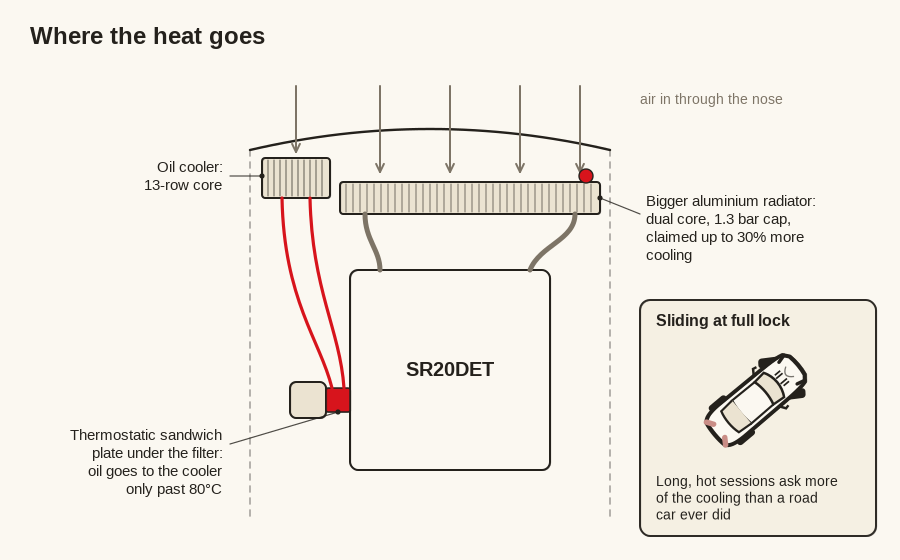
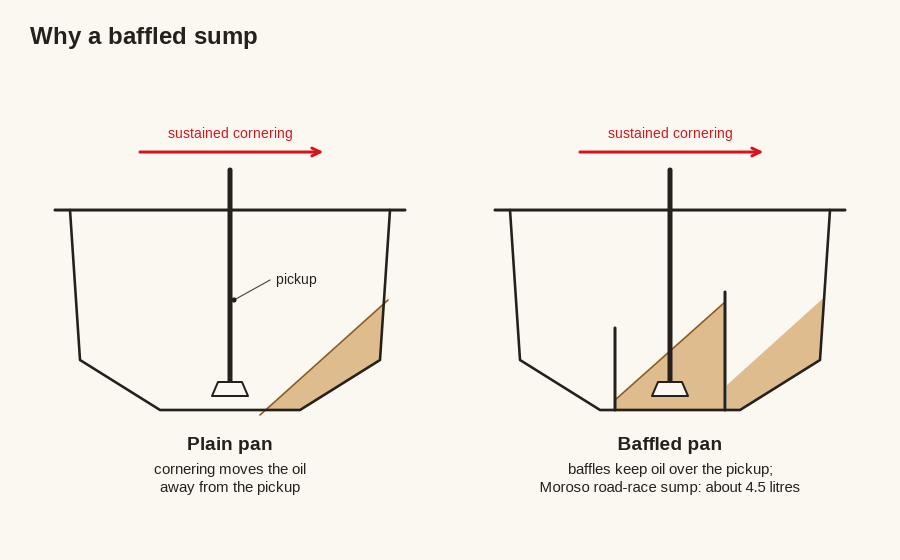
A larger aluminium radiator keeps coolant in its safe window longer. Mishimoto's S14 part uses a dual-core brazed design and a 1.3 bar cap, with a claimed cooling gain of up to 30 per cent over factory. A thermostatic sandwich plate under the oil filter diverts oil to a cooler once it climbs past 80°C, and not before. A baffled sump keeps oil over the pickup when sustained cornering tries to move it away, and that is the point of it.
The Options And The Costs
Direct-fit radiators sit at the OEM location and bolt in. At the time of writing, Torque GT UK lists the Mishimoto MMRAD-S14-95SR at £321.46 including VAT; Japspeed's own-brand race radiator for the SR20DET S14, S14a and S15 is £249.99. Japspeed also claim up to 30 per cent more cooling capacity.
An oil cooler starts with the sandwich plate: the Mocal M-OTSP-1 thermostatic plate is £96.20 at Merlin Motorsport, add a 13-row core and some lines and you have a real cooler.
For the oil pan, Moroso's road-race baffled wet sump for the SR20 holds about 4.5 litres and costs £464.99 to £516.65 at UK sellers. Nissan's own factory baffle plate (part 11113-65F00) is the cheap partial fix, if you want to keep the stock pan.
The Catch
A radiator and sandwich plate are a weekend in a decent home garage. A baffled sump is a bigger job, and one for a specialist.
Every one of these parts counts as a modification under the ABI's definition, and a UK insurer can void a policy if performance mods are not declared. Standard road cover usually excludes on-track driving, so track-day cover is a separate buy.
If you are this far into the build you already have the safety kit, the tyres, the brakes and an LSD. The cooling and oil spend is cheap insurance against the rebuild it prevents. Radiator first, then the oil cooler, then the baffle plate or baffled sump. You will spend real money keeping an SR20DET alive before you add a single extra horsepower, which is, I find, rather the point. Then, and only then, add boost.
Where our facts came from
- Wikipedia: Nissan Silvia (opens in a new tab) reference
- Nissan Motor Corporation: Silvia K's Type S (1994) — Nissan Heritage Collection No. 198 (opens in a new tab) manufacturer
- Mishimoto: Nissan 240SX S14 Performance Aluminum Radiator, 1995-1998 SR20 Engine (MMRAD-S14-95SR) (opens in a new tab) manufacturer
- Torque GT: Mishimoto Performance Aluminium Radiator — Nissan Silvia S14 / S15 (opens in a new tab) press
- Japspeed: Japspeed Nissan Silvia 200SX S14/S14a/S15 SR20DET Alloy Race Radiator (opens in a new tab) press
- Merlin Motorsport: Mocal Oil Sandwich Plate with Thermostat (M-OTSP-1), opens at 80°C (opens in a new tab) press
- RHD Performance: Moroso Oil Sump Pan — Road Race Baffled, Nissan SR20 (opens in a new tab) press
- Motorsport UK: Fire Extinguisher Regulation Reminder (opens in a new tab) governing-body
- Drift Matsuri UK: Drift Matsuri Spring 2026 — Anglesey Circuit entry rules (opens in a new tab) official
- Financial Ombudsman Service: Car modifications and insurance (opens in a new tab) governing-body


